Federica Marchionni Opens Global Fashion Summit 2026 with a Call for Resilience
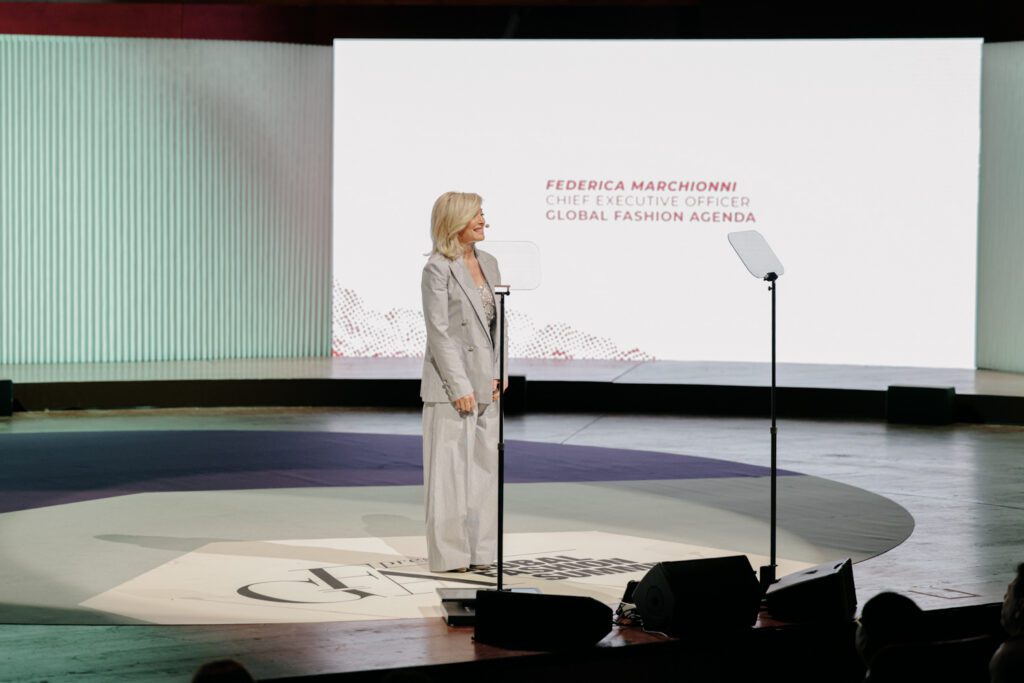
Global Fashion Summit: Copenhagen Edition 2026 convened more than 1,000 stakeholders from across fashion and adjacent industries in Copenhagen from 5–7 May. Through three days of content, networking and innovation showcases, the Summit explored the theme Building Resilient Futures and how the industry can turn ambition into measurable progress.
Opening the Summit, Federica Marchionni, CEO, Global Fashion Agenda, called on industry leaders to recognise resilience not as stability, but as the ability to adapt, collaborate, and act amid disruption. Against a backdrop of geopolitical uncertainty, shifting regulation, and accelerating technological change, the Summit explored how fashion can build systems capable of enduring and evolving. Revisit Federica’s opening remarks below.
“Your Excellencies, ladies and gentlemen and dear GFA Community, good morning and welcome to the Global Fashion Summit. Thank you for choosing to take action and join us today.
Over time, this gathering has become a globally renowned conference that enables the industry to collaborate in accelerating impact, aligning all efforts to undertake large-scale, system-wide change.
We convene core stakeholders like you across brands, retailers, innovation, science, academia, finance, policy and more – who believe that fashion is not merely about what we wear but about who we are, and who we choose to become.
What we build in this room does not stay in this room. It travels — into value chains, into communities, into the closets and lives of millions of people that this industry employs.
We are living in a moment that is anything but stable, and your presence is critical in this defining time of transition.
This year’s summit theme, ‘Building Resilient Futures’, highlights a major shift in fashion, as we need to adapt to shocks while moving toward sustainability.
The economic headwinds are real. The disruption is real. And it is precisely because they are real that we are here. Because here is what else is true.
Global trade routes have been disrupted in ways we could scarcely imagine five years ago. Inflation has squeezed consumers everywhere. Geopolitical tensions have redrawn supply chains almost overnight.
And the climate — always our silent co-author — continues to write its own terms. In 2025, more than 200 climate-related disasters affected more than 87 million people worldwide – fashion’s raw material base is on the frontline. Extreme weather has disrupted cotton harvests, flooding has shuttered factories, and wildfires have threatened wool-producing regions.
Avoiding a “Hothouse Earth trajectory” requires urgent actions this decade: rapid emissions reductions, protection of ecosystems, and systemic transformation before these cascading tipping points are triggered. The direction of travel is clear. The question is whether we respond in time. Do we shape the future, or wait for it to shape us? This is our moment to answer.
Every great leap in history has emerged not from comfort, but from pressure. Not from stability, but from necessity. The industrial revolution did not merely mechanize the loom — it created entirely new possibilities for what clothing could mean and who could afford it.
The post-war era gave birth to ready-to-wear and democratized fashion for the world. The more recent digital revolution put the power of discovery, community, and commerce directly into the hands of consumers and creators alike.
Disruption has always been our industry’s most reliable design brief. We have been here before — at the edge of the unknown — and we have always sown something extraordinary from it. The thread that runs through every revolution in this industry is the same: the imagination and the courage of people who chose to act.
There are people, organisations, and movements already driving this transformation forward—often faster than the systems around them. They are proving what is possible. We must amplify them. Support them. Learn from those who are brave enough to lead the way. Because progress is better than perfection. And the complexity of the ever-changing world keeps adding new challenges.
We are now living in the era of the Promise and the Responsibility of Artificial Intelligence, so let me speak directly about the most consequential of those revolutions — because it demands more than enthusiasm, which many of us understandably have. But it also demands honesty.
AI is already reshaping fashion at every level. And yet — for every efficiency that AI creates, many jobs hang in the balance.
Our industry employs people all over the world — from cotton farmers and textile workers, to brands, logistics, retail, and repair. The majority are in developing economies. When we automate a cutting room, a grading process, a quality inspection line — the productivity gain shows up in a quarterly report. The human cost can show up in other places, often far from us. It does not appear in the same spreadsheet. Yet, it is just as real.
AI can uplift fashion’s workforce or displace them. The choice belongs to the industry. Fashion has a genuine, rare opportunity to demonstrate that an industry can embrace new intelligence while becoming more human, not less. Let us not squander it.
Future-proofing a fashion business also requires a fundamental reallocation of capital. And that reallocation will not happen without the Chief Financial Officers. That is why I like to call them “the Architects of Resilience”.
For too long, too much capital in this industry has flowed toward mechanics to clear overstock that should not have been produced in the first place. The result is an industry that has chronically underinvested in the things that will determine its survival: products and supply chains.
CFOs must rewrite that equation.
The CEO may have the vision to shift this. But it is the CFO who controls the architecture of that shift — who can help decide which investments get funded and which get killed in the planning cycle.
The CFO who understands that supply chain resilience, materials innovation, traceability infrastructure, and workforce capability are not cost centers but sources of competitive advantage — that CFO is one of the most powerful people in the future of this industry.
To the CEOs across the industry: your CFO is either your greatest ally in this transition, or the most significant structural barrier to it. Choose the ones who are not just guardians of the current model, but partners a vision where finance evolves from cost controller to value architect. To the CFOs: that evolution can start with you!
We’ve spent years refining how we talk about our products. Now it’s time to rebalance how we invest in them.
Product is the foundation and where long-term value is built.
Brand image should never come at the expense of product quality — it should reflect it. For some, marketing budgets may exceed what we commit to product integrity, and that gap is no longer sustainable.
The industry must rebalance how money is spent across the value chain. The mandate is clear: invest more in substance! A shift of a few percentage points in the value chain can make a huge difference.
Another place where capital reallocation is urgently needed — and consistently neglected — is in the infrastructure of the circular economy.
We speak about circularity with great fluency in this industry. It appears in almost every sustainability report, every investor presentation, every brand manifesto. And yet, the gap between the ambition and the reality remains vast. Not because the will is absent. But because the infrastructure is not there.
This industry has made meaningful progress on post-industrial waste — the offcuts, the deadstock, the surplus fabric. Brands have found ways to recapture and redirect these materials, and that is genuinely commendable.
Post-consumer waste is an entirely different challenge — and it is the one that will define whether the circular economy in fashion is real.
Less than 1% of discarded garments are recycled into new clothing today. The circular economy isn’t failing — it’s not been built yet.
And it will be built by long-horizon infrastructure that requires exactly the kind of patient, courageous capital allocation we have been discussing.
This is not a challenge that brands can solve alone. It is an infrastructure one — and infrastructure requires the coordinated investments of both the private and public sectors.
It requires collection networks embedded in communities, not only in flagship stores. It requires recycling technologies scaled to commercial viability: few existing solutions are truly encouraging, but companies must commit to these technologies, and we need more of them for the circular economy to thrive.
Resilience is not a solo performance but a symphony of multiple interventions. When governments create frameworks for extended producer responsibility, brands that invest in circular design stop being penalized and start being rewarded. When industry consortia set shared standards for supply chain transparency, the cost of compliance falls for everyone.
I envision the unobvious. When I look at fashion through that lens, I see an industry at an inflection point — one where the companies willing to ask uncomfortable questions, to measure what truly matters, to invest where it is hard rather than where it is easy, acting decisively to solve real challenges, will emerge not just resilient, but genuinely transformed.
Throughout this Summit, we will showcase a range of creative and innovative responses that are designed to inspire hope, challenge thinking, and demonstrate what’s possible for the industry.
Let us decide what future we are going to build together. Thank you.”
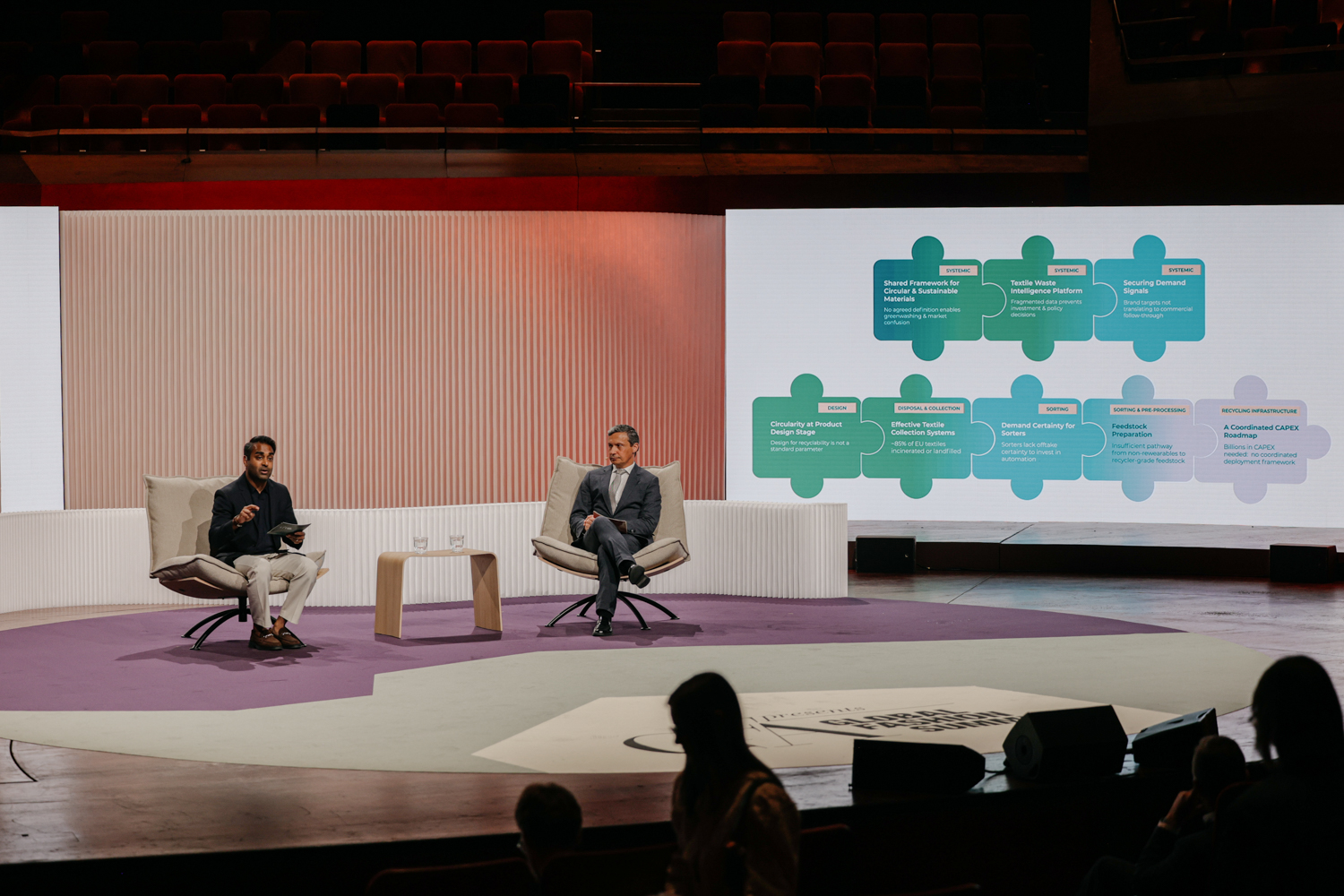
From 5-7 May, Global Fashion Summit: Copenhagen Edition 2026 convened over stakeholders from brands, retailers, NGOs, policymakers, manufacturers, innovators, and adjacent industries to advance collective action.

Global Fashion Agenda (GFA) and PDS Ventures have revealed Synflux as the winner of the Trailblazer Programme 2026.

New Report from Global Fashion Agenda and Boston Consulting Group Explains How CFOs Can Better Manage Sustainability-Driven Costs, Risks, and Opportunities