2025 Reflections and Seasonal Greetings
Dear GFA Community,
As we usher in 2026, I extend my gratitude to our dedicated community for another impactful year together.
It would, however, be remiss of me not to acknowledge the challenges that our industry has collectively faced this year – from climate catastrophes, and global supply chain disruptions, to the questioning of sustainability goals, and reshaping of cultural narratives. The industry’s collective capacity to withstand and adapt has been profoundly tested and the widening gap between climate ambitions and tangible implementation feels ever starker.
At GFA, we remain committed to guiding the industry through these complexities and have been encouraged by the adaptive and innovative thinking that we are witnessing firsthand across our community.
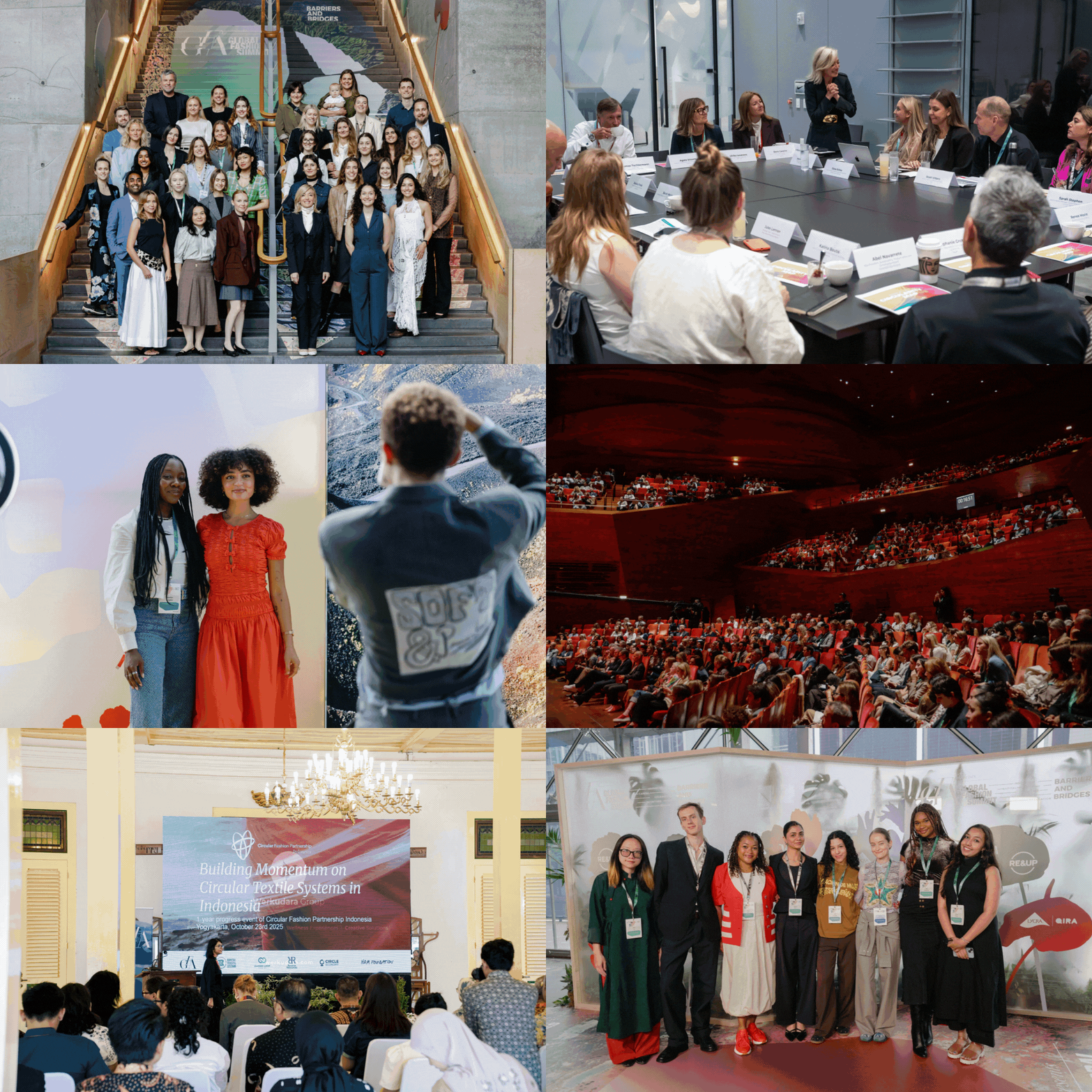
Overcoming barriers and building bridges was the cornerstone of Global Fashion Summit in Copenhagen in June, where dedicated fashion stakeholders convened around the collective ambition for a better future. This sentiment continued through to Climate Week NYC where GFA was proud to collaborate with its partners to host a number of action orientated roundtables, innovation networking sessions, and a policy masterclass.
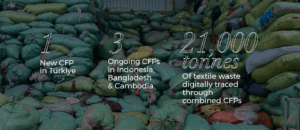
In addition to our productive convening moments, we accelerated our impact through programmes centred on circularity, pay equity, and climate. We proudly launched the Circular Fashion Partnership: Türkiye, expanding on successful implementation in Bangladesh, Cambodia, and Indonesia.
This year, we’ve continued to equip thousands with tools and knowledge to support implementation, including the Fashion CEO Agenda 2025, Fashion Impact Toolkit, Policy Matrices EU & Americas, Apparel and Footwear Circularity Map, and Upstream Circularity Podcast.
As we reflect on a year marked by both challenges and opportunities, I’m also inspired by the leaders of tomorrow from our Next Gen Assembly and the innovative solutions platformed by our Trailblazer Programme. This is the ingenuity and optimism that bring me hope and can inspire a flourishing future for the fashion industry.
I once again reiterate my thanks to you – our vibrant GFA community. I believe sustainability can be a uniting bond among all of us, and a mindset for us to thrive. As we approach the new year, I wish you a restorative and reflective time and eagerly anticipate the impact we can cultivate together in 2026. Together we can build resilient futures for our industry, our planet, and generations to come.
Best wishes and happy holidays,
Federica Marchionni, CEO

GFA continued to lead implementation programmes to accelerate action. Some of our recent Impact Programmes include: the Global Circular Fashion Forum (GCFF), National Circular Fashion Partnerships, the Renewable Energy Initiative, and Pay Equity Research.
In 2025, the GCFF made meaningful progress across three key manufacturing countries and expanded its footprint with the launch of a new National Circular Fashion Partnership:
In 2025, the BESTSELLER Switch to Upstream Circularity Pilot in Bangladesh reached its conclusion, marking an important milestone in the country’s journey toward large-scale textile-to-textile recycling. Delivered under the SWITCH2CE initiative and led by UNIDO with support from GFA, BGMEA, Reverse Resources, Circle Economy, and others, the pilot strengthened the foundations of a domestic circular ecosystem. Through the programme, BESTSELLER worked with its manufacturers and nominated recycler CYCLO to continuously create garments containing recycled materials.
In October, the Circular Fashion Partnership: Indonesia marked its first anniversary with an event in Yogyakarta, where over 100 stakeholders from government, industry, and civil society reaffirmed their commitment to scaling circular solutions across the nation’s textile sector. Over the past year, the programme has laid key foundations for scale: 15 factories have been onboarded to the Reverse Resources platform, representing 7,000+ tonnes of monthly production, while ecosystem mapping has identified 25+ active recyclers nationwide. Early implementation has already strengthened waste segregation and enabled the first digitally traced tonnes of post-industrial textile waste.
In 2025, the GIZ-led pilot in Cambodia formally transitioned into the Circular Fashion Partnership: Cambodia, marking a significant step in strengthening circular systems across the country’s textile sector. The programme has gained strong early momentum, with PUMA, H&M, adidas, and lululemon joining alongside 24 manufacturers. Supplier activities advanced quickly: 14 textile waste management assessments were completed, and a national Training of Trainers programme certified 25 master trainers who will help embed circularity across the value chain. As CFP Cambodia progresses toward working with up to 80 factories, the partnership is laying the foundations for standardised, traceable, and scalable waste systems nationwide.
Earlier this month, GFA in collaboration with Rematters, Reverse Resources, Closed Loop Fashion, and the Circle Economy Foundation, and funded by H&M Foundation, announced the launch of the Circular Fashion Partnership: Türkiye. Beginning in early 2026, the programme will aim to accelerate textile-to-textile recycling in one of the world’s most influential manufacturing hubs.

At Global Fashion Summit, GFA, in collaboration with Deloitte, launched the Fashion Impact Toolkit, a broad resource designed to help businesses identify and manage sustainability impacts across the textile value chain.
The resource includes a contextual report and an interactive, user-friendly tool that supports textile, clothing, and footwear companies in navigating a rapidly evolving industry landscape. By mapping potential impacts, the toolkit empowers businesses to integrate impact data into strategy, drive innovation to reduce impacts, and create shared value — helping companies remain competitive and resilient in a complex market.
Download the report.
Unveiled at Climate Week NYC 2025, the Fashion CEO Agenda 2025 is GFA’s flagship strategic guide to help fashion leaders take immediate action and future-proof their businesses while working towards a net-positive industry by 2050.
Published at a critical mid-decade point — with less than five years to meet the UN Sustainable Development Goals — the report addresses the industry’s pressing challenges, from economic volatility to escalating climate and social crises.
Download the report.
During Climate Week NYC 2025, GFA also launched the Apparel and Footwear Circularity Map, a guide of collaborative initiatives driving circularity across the fashion system.
The map showcases programmes across every stage of the circular fashion system, from design through to end market, as well as ecosystem enablers that support system-wide change. It helps brands and retailers identify credible opportunities to engage, while guiding stakeholders on where to prioritise collaboration to scale impact.
Download the report.
GFA launched the Upstream Circularity Podcast – a limited series exploring the technical innovations, systemic shifts, and real-world solutions shaping the future of textile recycling.
Across four episodes, GFA hosts deep-dive conversations with leading experts across the fashion value chain, unpacking the Upstream Circularity Playbook and demystifying how waste can be transformed into new resources.
Read more and listen.

2025 has been a landmark year for textile policy, shaped by major EU initiatives and the global ripple effects of evolving U.S. measures. At Global Fashion Summit, the pre-event Policy Masterclass explored the opportunities and challenges arising from this rapidly changing context. The Summit also featured a keynote by Jessika Roswall, EU Commissioner for Environment, Water Resilience, and a Competitive Circular Economy, alongside four closed-door roundtables that convened industry leaders and policymakers for strategic dialogue.
Beyond the Summit, GFA continued to strengthen engagement across key policy arenas. We hosted a policy breakfast at the EU Parliament in Brussels, and a full-day event in Denmark offering recommendations to improve feedstock flows and advance textile-to-textile recycling across Europe. Extended Producer Responsibility (EPR) remained a central theme, with an OECD Forum side session bringing together global EPR practitioners, and a masterclass at Climate Week NYC 2025 examining the growing divergence between EU and U.S. approaches.
As 2025 draws to a close, the policy landscape remains marked by uncertainty. Companies that invested early in compliance now face shifting requirements and Omnibus measures that bypass standard processes, raising concerns around consistency and trust. At the same time, global trade tensions and U.S. tariffs are reshaping corporate strategies. The year ahead will require clarity, coherence, and renewed ambition — setting the stage for essential discussions at Global Fashion Summit 2026.
In 2026, GFA will continue to update and expand its Policy Matrices, covering the EU and the Americas, and advance its Mapping of Global EPR for Textiles, charting the proliferation of textile EPR schemes worldwide.
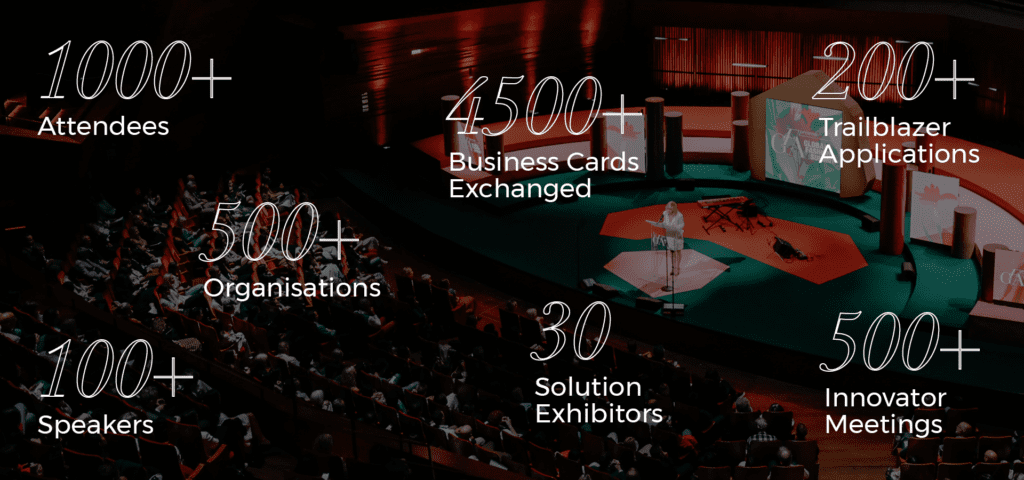
Global Fashion Summit: Copenhagen Edition 2025 brought together over 1,000 attendees from more than 500 organisations across six continents for two days of strategic dialogue, cross-sector collaboration, and solution-driven programming. This year’s Summit featured 100+ speakers and 18 roundtables, offering diverse perspectives on the industry’s most pressing sustainability challenges. More than 4,500 business cards were exchanged, underscoring the Summit’s role as a catalyst for meaningful partnership and action. Across the Innovation Forum, 30 exhibitors from 13 countries showcased pioneering solutions, while curated networking activities facilitated 500 introductions through Matchmaking sessions and Innovation Forum Tours.
During the Summit Celebration Dinner, GFA announced the winner of its Trailblazer Programme, delivered in partnership with PDS Ventures. The second edition received 200+ applications, with nine finalists invited to present at the Summit and the winning innovator, Refiberd, awarded up to USD 200,000 in support. The third edition is now open for applications, continuing to spotlight breakthrough innovations shaping the future of fashion.
Read more about the 2025 Summit here.
Thank you to everyone who joined us in Copenhagen. We look forward to welcoming you back for Global Fashion Summit: Copenhagen Edition 2026 on 5-7 May.
Secure your ticket here.
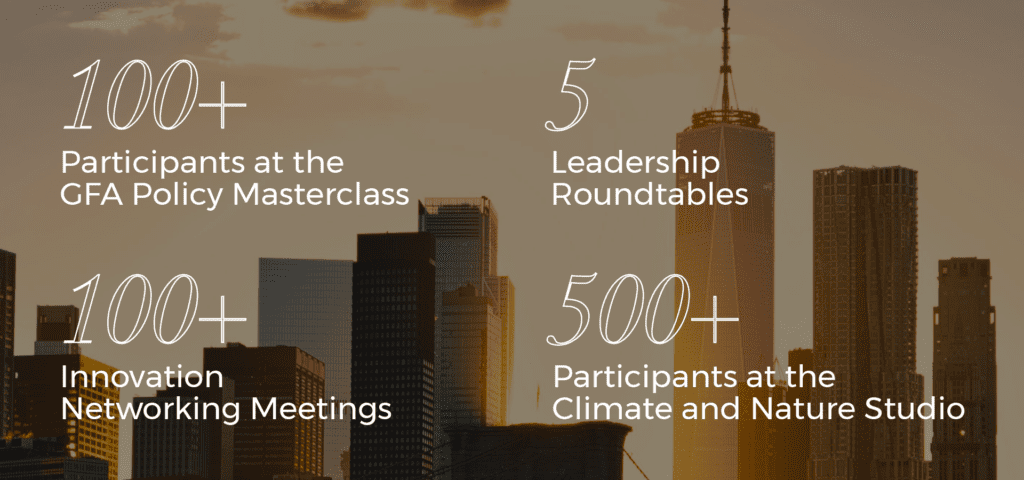
GFA was proud to engage its global community at Climate Week NYC 2025 through a high-impact programme of roundtables, events, and strategic collaborations that showcased industry leadership and accelerated action across climate, circularity, and policy. The week began with a landmark moment as GFA took part in the Nasdaq Bell Ringing Ceremony, spotlighting the collective urgency and opportunity for transformation across the fashion sector.
In partnership with Nike, GFA hosted the GFA Assembly at Nike’s NYHQ — a morning of deep, action-focused dialogue featuring five roundtables and over 80 attendees, exploring circularity, resale, climate finance, and post-industrial recycling. That same spirit of collaboration continued in the GFA Policy Masterclass, which brought together 100+ participants for a timely discussion on emerging U.S. and EU legislation, guided by four expert speakers.
GFA also partnered with Ralph Lauren to convene an Innovation Networking session at the Climate & Nature Studio, connecting 9 solution providers, 9 brands, and 13 financiers through 100+ strategic meetings designed to accelerate implementation of climate and circularity solutions. Across the two days, the Climate & Nature Studio hosted over 500 participants, reflecting the growing momentum behind nature-positive action.
To further strengthen alliances, GFA and RE&UP co-hosted an intimate Fashion Leaders Dinner, bringing together partners and allies committed to championing innovation, collaboration, and industry transformation.
Read more about the Climate Week NYC 2025 here.
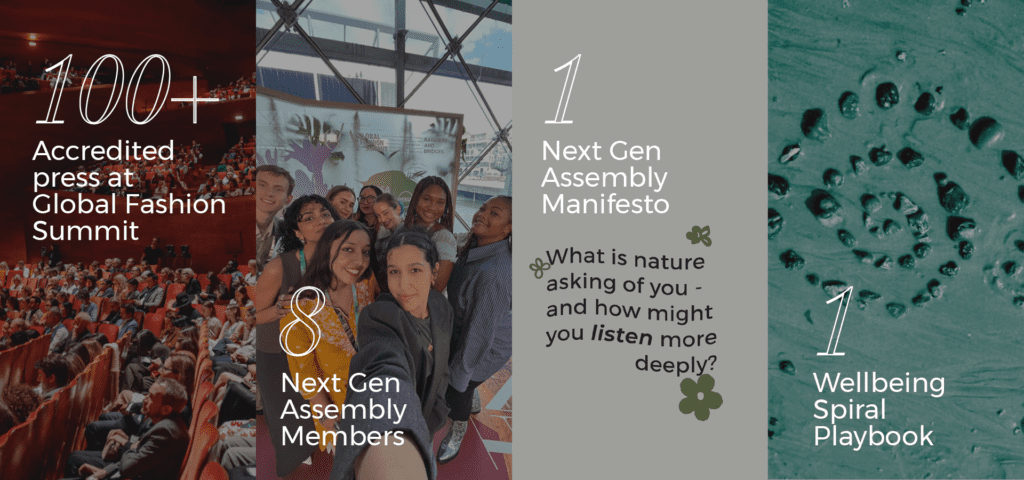
This year, we also welcomed a strong media presence at the Summit and extend our sincere thanks to all media and content creators who helped amplify key sustainability insights across global channels.
Furthermore, GFA announced a new season of the Fashion Redressed film series, produced in collaboration with BBC StoryWorks. Building on the success of the first edition, the new series will spotlight innovators advancing circularity, social equity, and technological progress, and will launch on BBC.com in early 2026.
In 2025 GFA also continued to expand its educational impact. Supported by Fashion Values and Target, we welcomed eight members to the 2025 Next Gen Assembly, who explored the theme “How Can Fashion Value the Rights of Nature?” and called for action through a creative social media campaign. This year’s cohort contributed at the Summit and collaborated on the Next Gen Assembly Manifesto, calling for a fashion system aligned with the living systems of the Earth. GFA also hosted an educational Masterclass, under the same theme, convening students, practitioners, and industry stakeholders.
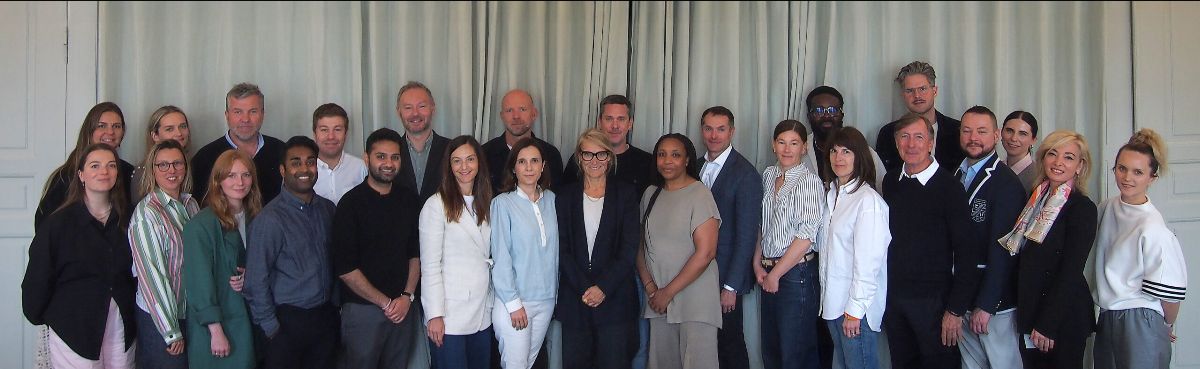
In 2025, GFA expanded its global network by welcoming three new partners. LVMH and eBay joined our Strategic Partner group, to further build our work on circularity, climate, and innovation. We also welcomed Lenzing as an Associate Partner, strengthening collaboration across responsible materials and fibre systems. Together, these partnerships reinforce our shared ambition to accelerate progress toward a net-positive fashion industry.
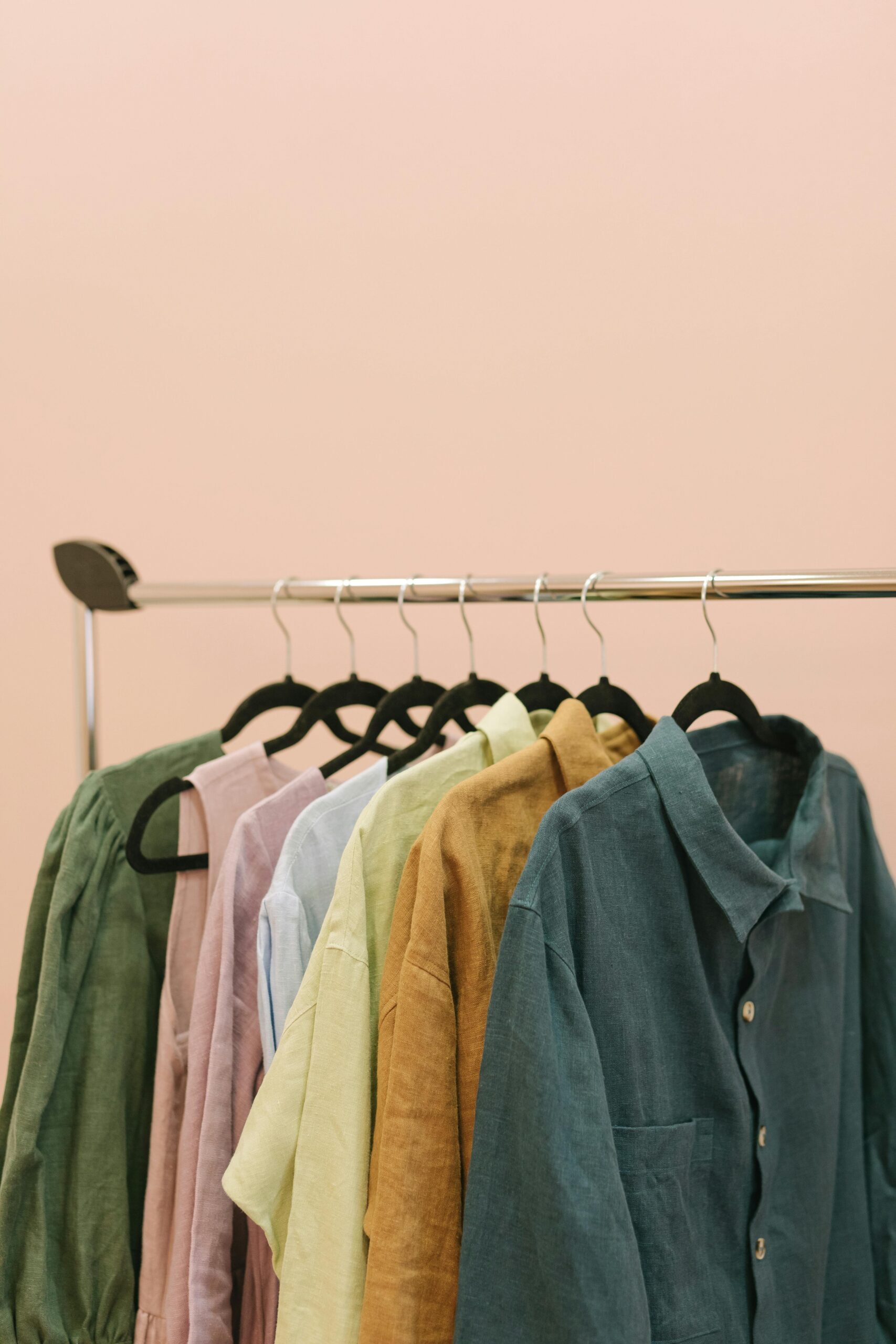
Overproduction is one of the fashion industry’s most challenging issues that is as much of a problem for a company’s bottom line as it is for the environment.

How the ‘words’ fashion uses shape what we desire, and what we keep.

Next Gen Assembly 2025 Member Elise Dauterive analyzes current EPR frameworks.