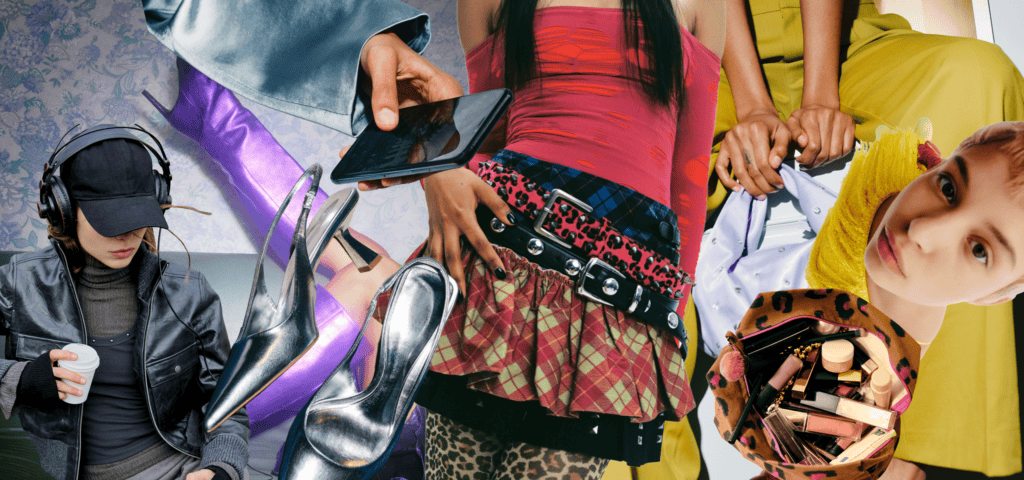
“Normal girl summer.” “Personal style is back.” “Viral trends are dead.” “Normanticisation is in.”
After the early 2020s domination of hyper specific trends and ‘aesthetics’, fashion appears to be experiencing trend fatigue, or at least that’s what the algorithm might be telling you. There is indeed a growing appetite for something less prescribed. Recent discourse has celebrated the concept of forgoing a manufactured and ultimately time bound ‘core’ and posits personal style and wearing whatever you like as an antidote to algorithmic trend chasing. Herein lies an obvious contradiction – as we herald the end of the microtrend, fashion coverage still promises to enlighten you with the “top street style sock trends” from fashion week and your social media feed will continue to present you with the very specific shade of lilac that will “ground and restore” you amidst the gloom of AW27. Even the rejection of trend culture itself has a number of marketable names (cast your mind back to the early 2010s popularisation of ‘normcore’ and you’ll note that this is by no means a new phenomenon.)
The end of the microtrend risks becoming a microtrend in itself.
From core to algorithmic whiplash
When we examined the era of microtrends in 2024, TikTok was churning out what seemed to be an endless succession of highly specific aesthetics. We needn’t remind you of the infinite absurdities that exist on Aesthetics Wiki, but the problem was not merely with the extensive list of names, but rather what this speed and turnaround time could encourage. Microtrends gave brands a continuous stream of cultural moments to commercialise and consumers a continuous stream of reasons to reconsider what they already owned, resulting in a kind of algorithmic whiplash of perpetual newness delivered through a feed designed to keep moving.
Earlier this year, New York Times chief fashion critic Vanessa Friedman drew a useful distinction between enduring fashion trends and microtrends. Deeper trends, she argued, can genuinely change the way we see and dress, while microtrends are more closely tied to the mechanics of social media, where algorithms repeatedly surface similar content until a fleeting aesthetic can appear ubiquitous. That distinction matters because what dominates our feeds can feel significant simply because we see it everywhere, but visibility is not necessarily the same as longevity.
Despite repeated declarations of their demise, microtrends have continued to resurface. As Friedman observed, the reported end of microtrends may itself be a microtrend.
The challenge of pinpointing personal style
Writing in The New York Times this month, Thomas Morton observed how difficult younger generations’ clothes are to decode. While previous youth subcultures could often be recognised through relatively consistent visual signals, today’s outfits can combine seemingly contradictory references, decades, and styles. This illegibility may in fact be the point. After years of the internet categorising outfits into increasingly precise aesthetics, being difficult to categorise can in itself be a form of individuality.
From a sustainability perspective this is noteworthy. Personal style can (and perhaps even should) be inconsistent by borrowing from contradictory references, evolving slowly, containing garments acquired years apart, and most significantly, not needing to be replaced every time the algorithm finds a new adjective to latch onto.
‘Normal girl summer’ captures something of this desire we routinely repackage to step outside the performance of constant newness, but the very moment that ‘normal’ acquires a label and accompanying aesthetic language, we find ourselves back in familiar territory.
Did subcultures ever disappear?
In 2024, we suggested that as trends became more commercialised, the risk of losing the original meaning and depth associated with subcultures was growing. However, writer Patrick Kho, who covers subcultures, challenges the notion that subcultures have been replaced by an endless remix of existing references. Looking to independent creative communities in Hong Kong and beyond, Kho argues that genuinely new cultural movements are still finding form, often away from the places and online spaces where the mainstream expects to find them.
Algorithms have made existing aesthetics extraordinarily easy to discover, replicate, and commercialise and a visual language that developed within a particular community can be detached from its original context, given a name, and circulated globally at extraordinary speed. The online obsession with categorising everything into a named aesthetic may also make us less adept at recognising culture that cannot yet be neatly described.
Kho points to creative communities producing work that resists easy definition, suggesting that the difficulty we have categorising some young people’s style isn’t evidence that subculture has disappeared, but that new forms of culture are happening somewhere the algorithm hasn’t fully translated yet.
The trend machine is still running at an unattainable pace
For all this apparent change, the machinery that helped create the microtrend era remains remarkably effective. A styling detail spotted outside a fashion show can generate a trend prediction before the day is over, a celebrity outfit can be replicated by a brand in no time, and a seemingly ordinary behaviour can acquire a catchy name and suddenly feel like a movement.
For brands and consumers alike, this creates a pace that is near impossible to stay abreast with. A viral aesthetic may offer an immediate opportunity to grasp at the ever elusive zeitgeist, but despite becoming increasingly rapid, conventional product development still operates on a different timeline and by the time a microtrend has been identified, translated into product, brought to market, sold, delivered, and eventually worn, the internet may already have moved on.
This opens up a different way of thinking about relevance and one which focuses on building products, identities, and communities designed to remain meaningful beyond a single moment on social media. The sustainability challenge of microtrends lies beyond labels like ‘balletcore’, ‘tomato girl’, or ‘quiet luxury’ and it is the corresponding speed, overproduction, overconsumption, and disposability that matter. If every cultural moment creates another reason for perfectly usable clothing to feel obsolete, changing the name of the trend does little to change its impact.
What happens if the feed itself changes?
There are signs that this fatigue extends beyond fashion. The growing interest in ‘analogue’ activities such as scrapbooking, knitting, physical books, print magazines, records, and photography beyond the iPhone has been framed as a response to lives increasingly mediated by screens. Fashion’s renewed interest in personal style could be part of the same impulse and a desire for experiences that feel more tactile, individual, and lived in. Of course, there is an irony here too in the fact that ‘going analogue’ becomes an identifiable aesthetic to adopt and something to shop for, thus, even opting out of the digital trend cycle risks becoming another trend within it.
This voluntary desire to spend less time preoccupied by screens is developing alongside a more structural shift. Governments around the world are increasingly debating or introducing restrictions on children’s access to social media, alongside broader measures intended to address young people’s experiences online.
Australia has already introduced restrictions for under 16s, while a number of other countries are considering or pursuing their own approaches. Across the EU, policymakers are also discussing stronger protections and age appropriate access for children. In the US, Meta has also reached a multistate settlement over allegations that Facebook and Instagram were designed to be addictive to young users, agreeing to introduce measures including daily usage limits, nighttime restrictions, and stronger age assurance systems. The direction is far from settled however, and in France for example, legislation that would have restricted social media access for under 15s was blocked by the Constitutional Council in August over concerns including freedom of expression and privacy.
These debates are, first and foremost, about children’s safety, wellbeing, and rights. They do also raise an interesting cultural question for fashion. Microtrends did not emerge simply because young people became more interested in trends but they flourished within a particular technological environment – algorithmic feeds capable of showing millions of people similar aesthetics, creators able to name and package them, brands able to respond, and consumers able to purchase their way into a look almost instantly through a type of ambient shopping.
So, what might happen if the next generation spends less of its adolescence inside that system? Social media restrictions would not end fashion trends and nor would regulation alone determine how young people form identities or communities, but changing the infrastructure through which culture is discovered could change the speed, scale, and character of trends.
The future of microtrends
Fashion will always have trends, they are a part of how culture, creativity, expression, and identity evolve and are important for these very reasons. However, the particularly accelerated and highly categorised version of trends that defined the ‘core’ era is what might change. In its place, we may see something messier, namely, personal style, contradictory references, and cultural identities that are harder to pinpoint.
Now, can a slower vocabulary translate into slower consumption? Truly and tangibly moving beyond the microtrend cycle means allowing trends to inspire as opposed to dictate consumption. In practice this could mean rediscovering something already in your wardrobe in lieu of buying the item that completes a new look, wearing the same items across seasons and aesthetics, and giving personal style enough time to actually become personal (which yes, can mean being messy at first, but who among us cannot reflect on our teenage styling retrospectively with a comforting level of cringe.)
For the fashion industry, it also means questioning whether relevance must always depend on newness and acknowledging the fact that products, brands, and communities can remain culturally meaningful without constantly responding to the next viral moment. Whether or not microtrends are losing their cultural grip is nuanced, but the most important thing going forwards is whether fashion can resist turning their purported demise into the next thing to buy.
 By Constance Beswick
August 28, 2026
By Constance Beswick
August 28, 2026